ERP Integration
for Manufacturers.
Your ERP, your floor and your CRM each hold part of the truth.
We connect them so every job has one record from quote to cash, starting with the systems you already own.
One record for every job,
quote to cash.
RADIN helps mid-market manufacturers build and protect their investment in AI with an independent AI readiness assessment before any deal is signed, an optional fractional Chief AI Officer, and the ERP and CRM systems to match, with no software quota behind the advice.
• HEAR IT FROM A CLIENT
See what our clients say
“RADIN stepped in and salvaged a very significant go-live date in two or three months, when we were at a failure point. That was massive for us as an organization. You said, listen, we can do this, and you’ve been able to do that.”
Rick Pace
HME. Three years working with RADIN.
What disconnected systems cost you
Six problems we see in almost every shop, and what changes once the systems talk.
Orders get retyped. Sales order to work order to invoice, entered once.
The floor and the ERP disagree. Counts, scrap and labor post against the job the same day.
Month-end takes weeks. Live ledgers close faster, with fewer spreadsheets in between.
The count on screen is wrong. Lots and bins tracked from the floor match the shelf.
Sales calls the plant for status. Real lead times and order status, right in the CRM.
The integration breaks on update. Someone owns it after go-live, in writing.
An integration is only as good as whoever keeps it running.
The build is the easy part. We stay for the rest.
• THE GUIDE, BY PARKER HENDRICKS
Written by Parker Hendricks, VP of Sales at RADIN Dynamics. Parker grew up on the floor of his father’s metal fabrication shop in Monroe, Georgia, and holds the AI seat at the Georgia Manufacturing Alliance. Updated September 2026.
Our view: if an integration quote doesn’t name who supports the connections after go-live, don’t sign it. The build is the easy part. Keeping it running is the job.
What ERP integration really involves
An integration moves the same fact between two systems without anyone retyping it. A sales order in the CRM becomes an order in the ERP. A finished count on the floor becomes inventory and job cost. It sounds simple, and the connection itself usually is. The work is agreeing what each field means, which system owns it, and what happens when the two disagree.
That groundwork is where projects slip. In Panorama Consulting’s latest survey, more than a quarter of organizations said their ERP project ran over budget (Panorama Consulting Group, 2026 ERP Report), and the most common reason was an unexpected need for more technology. Most of that is scope nobody mapped up front.
MES and ERP: who does what
| ERP | MES | When they’re connected | |
|---|---|---|---|
| Main job | Plans the work and holds the money | Tracks what happened on the floor | One record of each job from order to shipment |
| Knows | Orders, BOMs, routings, costs, inventory | Machine counts, scrap, labor, downtime | Real job cost before the job closes |
| Gets wrong alone | Assumes the floor ran to plan | Doesn’t know what the order was worth | Far less, because each checks the other |
Plenty of shops don’t run a separate MES at all. The floor data lives on paper or in a spreadsheet, and the same logic applies: get it into the ERP the day it happens.
Do it in house or bring in help
| Do it in house when | Bring in help when |
|---|---|
| You have a developer who knows both systems | Your IT department can’t manage an implementation like this in house |
| The connection is one-way and low volume | Orders, inventory and costs move both ways every day |
| You can support it for years | Nobody on staff would own it after go-live |
Questions that catch a bad quote before you sign
- Who supports the connections after go-live, and what does that cost each month?
- What happens when the ERP or the other system releases an update?
- How will we find out when a record fails to move, and who fixes it?
- Which data is out of scope, in writing?
- Will we own the integration code and documentation?
If a vendor can’t answer those in a sentence each, the quote is for a demo, and you’ll pay for the rest later.
Where Business Central fits
When a shop between roughly $10M and $300M is ready to move off QuickBooks or an aging ERP, Business Central is often a good fit, and we have our own tool for the move. When your current ERP still does the job, we connect it and leave it alone.
Where to start. Book a 30 minute call. Bring the workflow you want to fix, or the proposal someone just sent you. Your AI readiness assessment is included, and if your shop isn’t ready for AI yet, you’ll hear it from us first. Book a 30 minute call.
The Microsoft work
behind the plan
As a Microsoft Partner we build on Dynamics 365 and the Power Platform when the plan says so. We still hold no software quota.






What we build for manufacturers
Three products. Each one closes a blind spot the last one left open.
RADIN AI Solutions
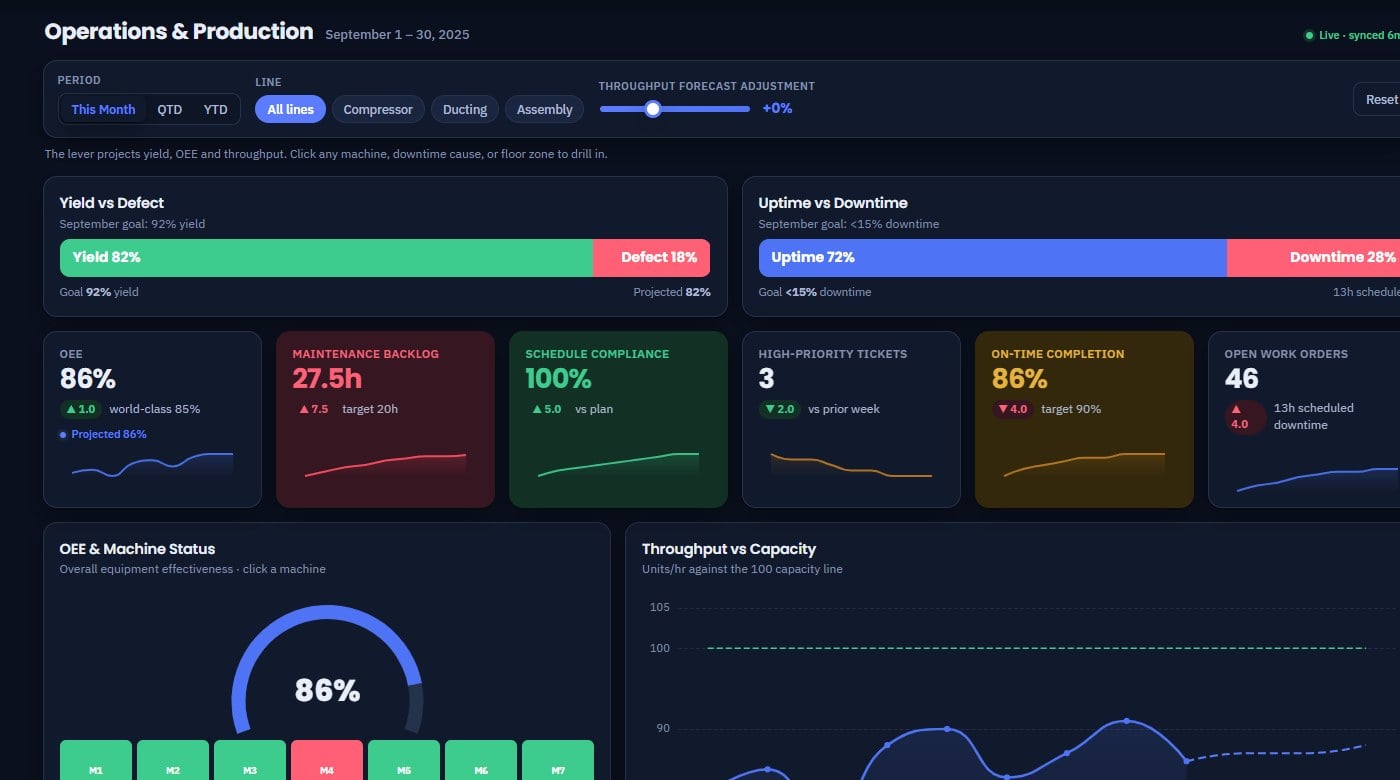
Move beyond dashboards and reports. RADIN AI helps manufacturers predict disruptions, identify inefficiencies, and take action faster by transforming operational data into practical, business-ready intelligence.
Business Central for Manufacturers
Disconnected operations create costly blind spots. Business Central brings finance, inventory, production, purchasing, and supply chain together in a single system so leaders can make faster decisions with greater confidence.
Dynamics 365 Customer Engagement for Manufacturers
Stop chasing information across emails, spreadsheets, and disconnected tools. Dynamics 365 CE helps manufacturers manage customers, service, sales, and relationships in one connected platform, giving teams the visibility needed to win and retain business.
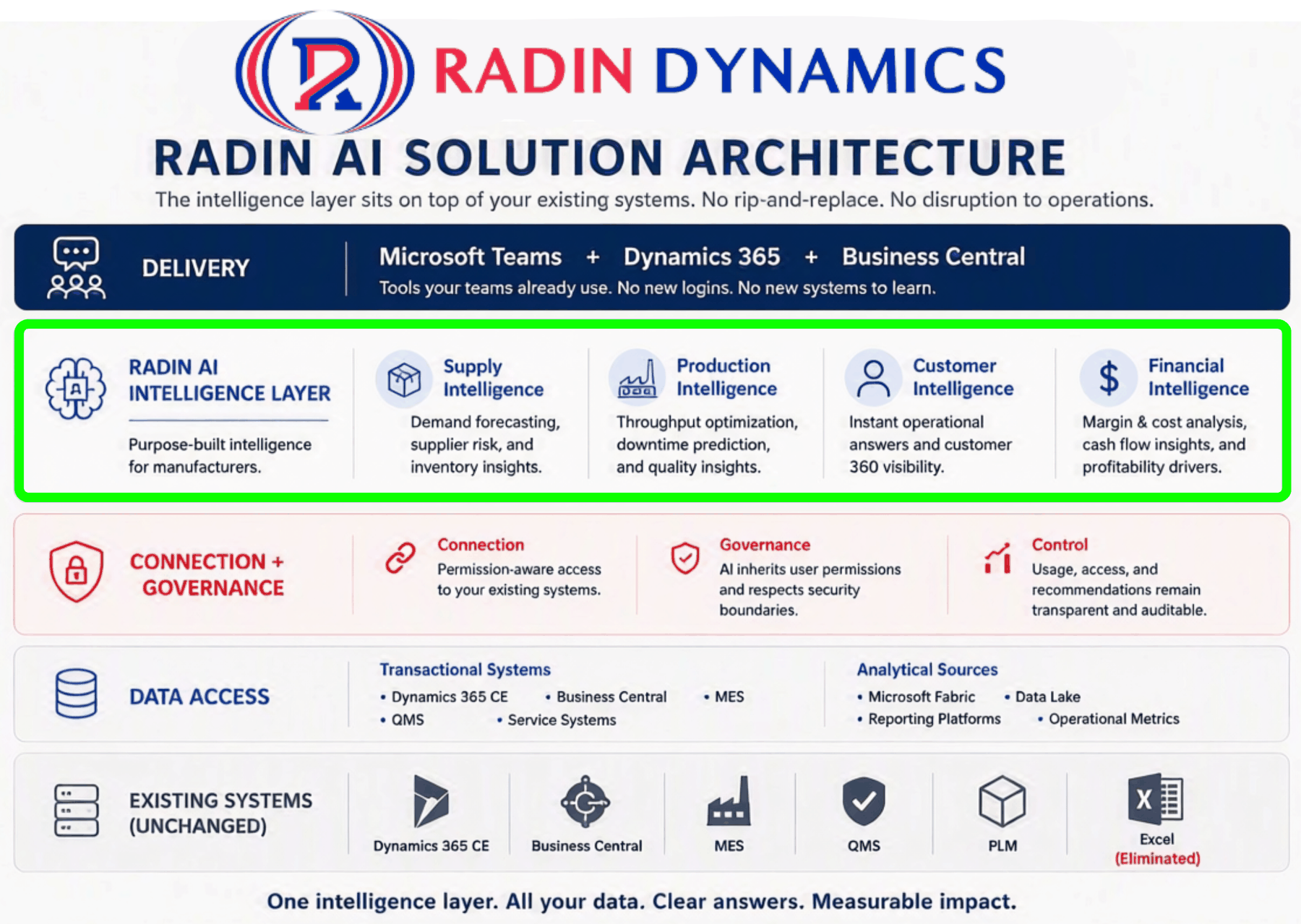
Where the AI layer sits
The green box marks the RADIN layer. It sits on top of the systems you already run, inside the tools your team already opens.
The Microsoft work
behind the plan
As a Microsoft Partner we build on Dynamics 365 and the Power Platform when the plan says so. We still hold no software quota.


What we build for manufacturers
Three products. Each one closes a blind spot the last one left open.
RADIN AI Solutions
Move beyond dashboards and reports. RADIN AI helps manufacturers predict disruptions, identify inefficiencies, and take action faster by transforming operational data into practical, business-ready intelligence.
Business Central for Manufacturers
Disconnected operations create costly blind spots. Business Central brings finance, inventory, production, purchasing, and supply chain together in a single system so leaders can make faster decisions with greater confidence.
Dynamics 365 Customer Engagement for Manufacturers
Stop chasing information across emails, spreadsheets, and disconnected tools. Dynamics 365 CE helps manufacturers manage customers, service, sales, and relationships in one connected platform, giving teams the visibility needed to win and retain business.
Where the AI layer sits
The green box marks the RADIN layer. It sits on top of the systems you already run, inside the tools your team already opens.
Connect what you own.
Replace only what you must.
When Business Central is the right ERP, we have our own tool for the move off QuickBooks or a legacy system. When your current ERP still does the job, we connect it and leave it alone.
Start where your shop is
A broken system needs the foundation first. Decent systems with no AI plan need the judgment. Most shops need both, in that order.
-
AI readiness assessment
Included when you work with us. Where AI fits on your floor and where it doesn't, before a dollar is spent. -
Fractional Chief AI Officer
$5,000 a month, 90 days then month to month. 16 hours, tracked. Any vendor quote answered inside 48 hours. -
CRM Health Check
Free. A current-state map, a 90-day plan and a one-pager for the board. Shops from $10M and 20 people. -
ERP for manufacturers
From $10M to $300M, with our own tool for the move off QuickBooks or a legacy system. -
CRM for manufacturers
Quoting and the customer file, connected to the floor and the books. Built only for manufacturers.
The numbers behind this
More than a quarter of organizations say their last ERP project ran over budget (Panorama Consulting, 2026).
Zero
software quota behind our advice
Start where your shop is
A broken system needs the foundation first. Decent systems with no AI plan need the judgment. Most shops need both, in that order.
-
AI readiness assessment
Included when you work with us. Where AI fits on your floor and where it doesn't, before a dollar is spent. -
Fractional Chief AI Officer
$5,000 a month, 90 days then month to month. 16 hours, tracked. Any vendor quote answered inside 48 hours. -
CRM Health Check
Free. A current-state map, a 90-day plan and a one-pager for the board. Shops from $10M and 20 people. -
ERP for manufacturers
From $10M to $300M, with our own tool for the move off QuickBooks or a legacy system. -
CRM for manufacturers
Quoting and the customer file, connected to the floor and the books. Built only for manufacturers.
The numbers behind this
More than a quarter of organizations say their last ERP project ran over budget (Panorama Consulting, 2026).
Zero
software quota behind our advice
Questions
ERP Integration: Common Questions
What do ERP integration services include?
Mapping how data should move between your ERP, shop floor systems, CRM and spreadsheets, building those connections, testing them against real orders, and supporting them after go-live.
How do MES and ERP work together?
The ERP plans the work and holds the money. The MES tracks what actually happened on the floor. Connected, the ERP gets real counts, scrap and labor by job, and the floor gets the right orders and routings.
Do we have to rip out our current systems?
No. We start with what you run and connect it. If a system can’t do the job, we’ll show you why before anyone quotes a replacement.
Should we do the integration in house?
If you have a developer who knows both systems and has time to support the connection for years, it can work. Most manufacturers our size don’t, and their IT department can’t take on an implementation like this in house.
What questions catch a bad ERP integration quote?
Ask who supports the connection after go-live, what happens when either system updates, how errors get reported, and which data is out of scope. A quote that can’t answer those isn’t ready to sign.
Is this built for manufacturing?
Yes. We only work with manufacturers, so production orders, routings, lots and job costing are where we start.
• Built only for manufacturers
We know which floors
we belong on
Manufacturing of every kind, from job shops and fabricators to machinery builders and the suppliers feeding aerospace, defense, medical and electronics.
Who we work with
Manufacturers with 20 to 1,000 people and $10M+ in revenue, from founder-led job shops to larger manufacturing organizations. If aging or disconnected systems are holding you back, we help you plan and deliver the right AI, ERP, and CRM improvements.
Manufacturing
Know what a job really cost. See the floor without three phone calls.
• Built only for manufacturers
We know which floors
we belong on
Manufacturing of every kind, from job shops and fabricators to machinery builders and the suppliers feeding aerospace, defense, medical and electronics.
Who we work with
Manufacturers with 20 to 1,000 people and $10M+ in revenue, from founder-led job shops to larger manufacturing organizations. If aging or disconnected systems are holding you back, we help you plan and deliver the right AI, ERP, and CRM improvements.
Manufacturing
Know what a job really cost. See the floor without three phone calls.
People who have stood
where you stand
Parker Hendricks grew up on the floor of his father’s metal fabrication shop in Monroe, Georgia. He holds the AI seat at the Georgia Manufacturing Alliance and hosts The unManufactured Show.
Sixteen years of Dynamics delivery behind him, a hybrid US and offshore team, and one rule: we show up, we do what we say, and we don’t disappear after the handshake.
“We build on the Microsoft stack, and where it fits your shop we will scope it. So here is our rule: we disclose what we earn on anything we recommend.”
Parker Hendricks, VP of Sales

People who have stood
where you stand
Parker Hendricks grew up on the floor of his father’s metal fabrication shop in Monroe, Georgia. He holds the AI seat at the Georgia Manufacturing Alliance and hosts The unManufactured Show.
Sixteen years of Dynamics delivery behind him, a hybrid US and offshore team, and one rule: we show up, we do what we say, and we don’t disappear after the handshake.
“We build on the Microsoft stack, and where it fits your shop we will scope it. So here is our rule: we disclose what we earn on anything we recommend.”
Parker Hendricks, VP of Sales
Book a 30 minute call
Bring the integration quote someone just sent you, or the spreadsheet your team retypes every week. We’ll tell you what it takes to connect it, and what to leave alone.